Friday, March 31, 2006
Laurie Anderson
I've no idea how long this video [edit: now removed] will remain on YouTube. I have no idea whether Ms Anderson, or whoever owns the copyright, has agreed to it being posted to YouTube. So I'll just link to the video rather than embed it in my blog.
It is, without doubt, the wierdest record to ever become a top 5 bestseller in the UK. I loved it at the time, and still love it now. If only more good poets could hurdle the mainstream popularity barriers - without losing their vision and integrity - like Laurie Anderson.
Thursday, March 30, 2006
Squirrel video
Rather than scare the horses with a video of me committing poetry, I thought I'd start with a shortish video involving fluffy little squirrels.
You have been warned ...
Be very afraid ...
... for Rik has just discovered youtube.com.
Video RikVerse readings coming to a website near you shortly ...
Tuesday, March 28, 2006
Things to do with a dead cat
We chose to end Fritz's life simply because she was old - her kidneys were failing, her eyesight was failing, her hips and joints were failing. She was probably a little senile.
Cats just aren't supposed to survive 20 years in the wild, and most cats die before they reach 15. Some people have suggested that it would have been kinder to have her put to sleep last autumn when she started to lose weight - when the vet told us that every day she remained with us was a blessing. She chose to bless us with her presence for another 6 months. But in the end she was beginning to show her pain to us. I think she knew it was time to get us to do the decent thing for her.
Fritz had a good life after she was rescued and taken in by our friend Lucy. And when Lucy decided to spend some time travelling Fritz came to stay with us. She settled in so well with my partner - at a particularly harrowing time in his life - that everyone agreed that it would be cruel to make her move home again. She stayed with us for just over 14 years.
She liked her birthday celebrations - for us an excuse to drink the hair of the cat after the New Year Celebrations. We have no idea when her real birthday was, though it is very likely she was born sometime in 1986. It's also possible that she had had a litter of kittens when she was young - maybe that's why someone chose to throw her out with the trash. She certainly hated the sight of bin-liners.
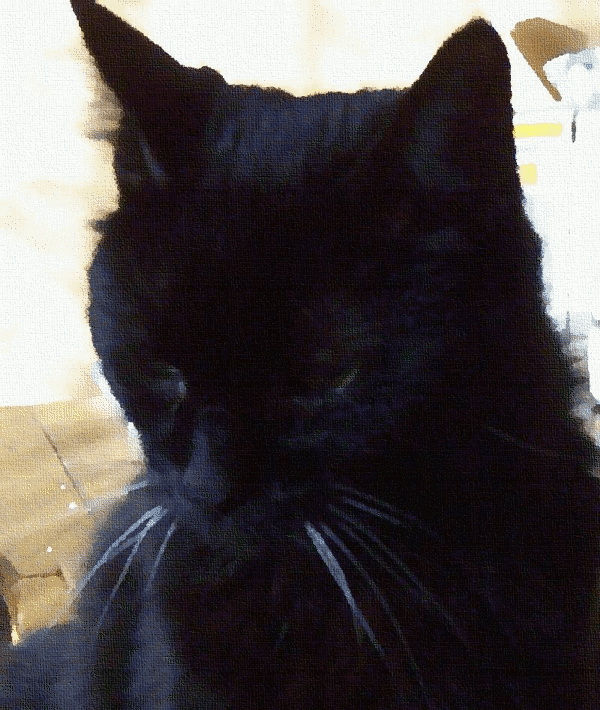
I don't want to remember her during the last few months of her life. Rather I will remember her as the cat that would go mad at the sight of a bird through the window and yet completely ignore any bird that came near her. She adored warm sunshine, good food and a long session of brushing, but preferred to garner attention on her terms, not ours.
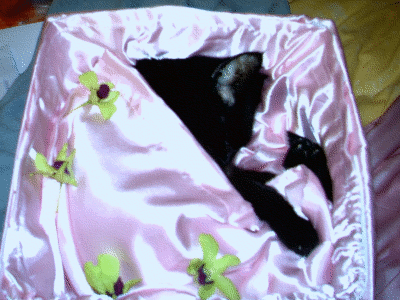
We chose to have her cremated, but first bought her body back home after accompanying her on her last journey. Rather than hand her over to the man from the pet crematorium in a plastic bag we decided to make her her own little coffin.
She was, after all, a lady.
Cats just aren't supposed to survive 20 years in the wild, and most cats die before they reach 15. Some people have suggested that it would have been kinder to have her put to sleep last autumn when she started to lose weight - when the vet told us that every day she remained with us was a blessing. She chose to bless us with her presence for another 6 months. But in the end she was beginning to show her pain to us. I think she knew it was time to get us to do the decent thing for her.
Fritz had a good life after she was rescued and taken in by our friend Lucy. And when Lucy decided to spend some time travelling Fritz came to stay with us. She settled in so well with my partner - at a particularly harrowing time in his life - that everyone agreed that it would be cruel to make her move home again. She stayed with us for just over 14 years.
She liked her birthday celebrations - for us an excuse to drink the hair of the cat after the New Year Celebrations. We have no idea when her real birthday was, though it is very likely she was born sometime in 1986. It's also possible that she had had a litter of kittens when she was young - maybe that's why someone chose to throw her out with the trash. She certainly hated the sight of bin-liners.
I don't want to remember her during the last few months of her life. Rather I will remember her as the cat that would go mad at the sight of a bird through the window and yet completely ignore any bird that came near her. She adored warm sunshine, good food and a long session of brushing, but preferred to garner attention on her terms, not ours.
We chose to have her cremated, but first bought her body back home after accompanying her on her last journey. Rather than hand her over to the man from the pet crematorium in a plastic bag we decided to make her her own little coffin.
She was, after all, a lady.
Monday, March 27, 2006
Fritz: 2 Jan 1986 - 27 Mar 2006

I cannot sing for you, my cat:
my throat is poorly shaped for song
and words get stuck behind the plumb
that swings above my tongue. But then
your voice was rarely raised, my cat:
I thought you were a statue kept
beside the fridge, so scared to move
in case some two-leg freak returned
to bag you, bin you. Yet a cat
can overcome - you always sought
the sun to russet up your fur,
the warmth of quiet fuss: no need
to entertain your hosts, my cat,
by chasing ropes or catching birds;
just sit, and eat, and sometimes purr
when watching from the kitchen shelf.
Website housekeeping
I've updated the look'n'feel of my poetry pages - the old look was getting a bit boring. The changes aren't finished yet - I'm in the process of doing some background images to liven up the poem pages. Nothing too obtrusive, though: the text remains the most important part of the webpage!
I've also decided to close the poetry magazine listing service - even though people said they liked it, the data was getting a bit mouldy and past its sell-by date.
Friday, March 24, 2006
A seventh poem of love?
When I first drafted #7, I loved it. This was the Dog's Bollocks, I thought. The next day I wasn't so sure it was the best thing I'd ever written, the day after I thought it was a reasonable draft. Now, I hate the original draft. Reading it pains my eyes.
Let's hope this redraft manages to calm my eyes for a little while:
Love Poem #7
So many garments
rolled tight to fit
in this cupboard.
"When did we stop
dressing up to keep
each other entertained?"
Such a stupid hat, ribbons
and shoddy cloth worn
one day at a fair.
"Prune the drawers:
shirts, jeans, boots -
bag them for charity."
We fleece each other,
let fall rags and jewels:
fingers trace the drapes of skin.
"Let others consider
old skins, browse
for a cap, or a shoe."
Thursday, March 23, 2006
Space eagles
This thread on ZBB, started by Eddy the Great, got me thinking about how a creature could evolve to survive both on planets and in space.
On planets, the creature will need all the adaptions associated with living on land, for example: skeletal and protective structures; locomotive features; energy capture, storage and digestion systems; metabolic control and excretion systems; an internal mass transit system; some form of reproductive strategy.
There will need to be a reason for creatures to venture into space. There's no food out there, no potable water. So the only reasonable possibility (to me) seems to be that the creature is either escaping something on the planet, or is aiming to get somewhere better. Which seems to suggest that we're dealing with a twin planet system (2 planets orbiting each other around a common point, which in turn orbits the star), or perhaps a system where 3 (or 6) similar sized planets are locked in similar orbits around a star each roughly at the lagrange points of the other planets. To be exotic, we could go with a combination option.
So, let's start with something that I'll call a space eagle. Big, birdlike, but definitely not a bird. They evolved in a starsystem that had 4 similar sized planets (say between Mars and Earth size) in a lockstep orbit around their star, 2 of the planets circling each other and the other two at the lagrange points to the binary (no, it's not a stable setup, but then we only need it to last for say 20 million years or so to allow the evolution to develop and refine our space cadets).
Now we need a way to get our space eagle into space. From Earth's surface you need to be going slightly faster than 11km/s to escape the planet's gravity well. On Mars the space eagle could soar into space if it were going faster than around 5km/s. The only way I can think of an organism achieving such speeds is through some sort of organic spacegun. Let's imagine a plant-like organism that's developed a gun-like mechanism for launching its seeds into space. Then our proto space-eagles come along and co-adaptive evolution 5 million years down the road leads to a plant - I'll call it gunweed - that will launch an eagle into space alongside its own seeds.
Whatever planet we're launching from, our eagle is going to need some protection against air friction. Let's say our gunweed provides this through the seed's outer layers. So, plant grows seed, waits for eagle to burrow into seed, then completes the growing process and launches seed into space.
Now, if the space eagle stays inside the seed it should be relatively safe in space (if it is in deep hibernation) until just before the seed hits the next planet. We'll assume that the evolutionary deal between gunweed and space eagle is that the gunweed gets seed and eagle into space, but it's the space eagle's job to get the essential part of the seed safely to the surface of the next planet. So the space eagle needs to "hatch" as the seed nears the next planet.
At this point, the space eagle needs some sort of locomotive system - farts could do it. Gas could be generated from food stored in the seed (which the space eagle could eat before breaking the seedcase). Once outside the seedcase, the space eagle needs to be impermeable (except when it's farting) - to maintain body pressure and prevent waterloss, so maybe a structure of interlocking feathers with a tough outer coating of oils and waxes.
Radiation is going to be a bugger. I assume the space eagle is going to develop some sort of sensory apparatus to warn it that a solar flare is on its way, then it can use the bulk of the planet that it's orbiting to hide between during the radiation storm. The alternative would be to have plates of subcutaneous lead, or filigrees of lead across the feathers, but that would be too much weight to launch. A really efficient way to clean up free radicals in the body would be fairly essential, together with especially effective ways of dealing with the resultant tumours. Another option is to just let the older space eagles die of cancer.
What next? Wings, with parachute-like properties, to get through the new planet's atmosphere. We'll assume that the space eagle has enough fart to get it into some sort of low geostationary orbit, after which it's just a case of losing speed and altitude slowly enough to allow for re-entry without excessive incineration.
Then all that's left to do is navigate passport control, declaring the ready-to-germinate remnants of the seed if necessary, and its Welcome to Your New World! Breed! Grow Gunweed! Be Happy! Until it's time for the next space voyage ...
On planets, the creature will need all the adaptions associated with living on land, for example: skeletal and protective structures; locomotive features; energy capture, storage and digestion systems; metabolic control and excretion systems; an internal mass transit system; some form of reproductive strategy.
There will need to be a reason for creatures to venture into space. There's no food out there, no potable water. So the only reasonable possibility (to me) seems to be that the creature is either escaping something on the planet, or is aiming to get somewhere better. Which seems to suggest that we're dealing with a twin planet system (2 planets orbiting each other around a common point, which in turn orbits the star), or perhaps a system where 3 (or 6) similar sized planets are locked in similar orbits around a star each roughly at the lagrange points of the other planets. To be exotic, we could go with a combination option.
So, let's start with something that I'll call a space eagle. Big, birdlike, but definitely not a bird. They evolved in a starsystem that had 4 similar sized planets (say between Mars and Earth size) in a lockstep orbit around their star, 2 of the planets circling each other and the other two at the lagrange points to the binary (no, it's not a stable setup, but then we only need it to last for say 20 million years or so to allow the evolution to develop and refine our space cadets).
Now we need a way to get our space eagle into space. From Earth's surface you need to be going slightly faster than 11km/s to escape the planet's gravity well. On Mars the space eagle could soar into space if it were going faster than around 5km/s. The only way I can think of an organism achieving such speeds is through some sort of organic spacegun. Let's imagine a plant-like organism that's developed a gun-like mechanism for launching its seeds into space. Then our proto space-eagles come along and co-adaptive evolution 5 million years down the road leads to a plant - I'll call it gunweed - that will launch an eagle into space alongside its own seeds.
Whatever planet we're launching from, our eagle is going to need some protection against air friction. Let's say our gunweed provides this through the seed's outer layers. So, plant grows seed, waits for eagle to burrow into seed, then completes the growing process and launches seed into space.
Now, if the space eagle stays inside the seed it should be relatively safe in space (if it is in deep hibernation) until just before the seed hits the next planet. We'll assume that the evolutionary deal between gunweed and space eagle is that the gunweed gets seed and eagle into space, but it's the space eagle's job to get the essential part of the seed safely to the surface of the next planet. So the space eagle needs to "hatch" as the seed nears the next planet.
At this point, the space eagle needs some sort of locomotive system - farts could do it. Gas could be generated from food stored in the seed (which the space eagle could eat before breaking the seedcase). Once outside the seedcase, the space eagle needs to be impermeable (except when it's farting) - to maintain body pressure and prevent waterloss, so maybe a structure of interlocking feathers with a tough outer coating of oils and waxes.
Radiation is going to be a bugger. I assume the space eagle is going to develop some sort of sensory apparatus to warn it that a solar flare is on its way, then it can use the bulk of the planet that it's orbiting to hide between during the radiation storm. The alternative would be to have plates of subcutaneous lead, or filigrees of lead across the feathers, but that would be too much weight to launch. A really efficient way to clean up free radicals in the body would be fairly essential, together with especially effective ways of dealing with the resultant tumours. Another option is to just let the older space eagles die of cancer.
What next? Wings, with parachute-like properties, to get through the new planet's atmosphere. We'll assume that the space eagle has enough fart to get it into some sort of low geostationary orbit, after which it's just a case of losing speed and altitude slowly enough to allow for re-entry without excessive incineration.
Then all that's left to do is navigate passport control, declaring the ready-to-germinate remnants of the seed if necessary, and its Welcome to Your New World! Breed! Grow Gunweed! Be Happy! Until it's time for the next space voyage ...
Tuesday, March 21, 2006
Fourth time lucky
Love Poem #5
When I fed you I set you three courses:
oysters from Whitstable, a carnival
of slime singed with lemon, edged
from ashtray shells and gulped;
a testicle of truffle, shaved
into a soft scramble of eggs and cream
and served on toast - crumbs brushed
from your chin by my thumb, each morsel
followed by a froth of champagne;
figs stuffed with mole, the bitter
chocolate squeezed from the fruit
as you bit the sweet flesh.
When we fed guests you set me:
rings of calamari around a candle
guttering its wax into my navel;
frets of watercress stems woven
through the down between the hooks
of my hips, dripping from the rinse;
a pharaoh's necklace - layers of mango
intersliced with pear flesh, molded
to the folds of muscle and fat
and bone lacing my heart within
its cavity, safe from the scavengers
snuffling through our house.
I'm going to get that second strophe right even if it bloody kills me!
Sunday, March 19, 2006
Love Poems: the sequence
Okay, I wasn't planning to do this. My original intention was to teach myself how to write a love poem because I haven't written, well, any proper love poems before. So I dashed off a dozen candidates over the course of a couple of weeks. And then I started workshopping them.
The results of the poems that I have workshopped to conclusion (#s 1, 2, 3, 4 and - just about - 6) are very pleasing to me. My redraft of #5 has distinct possibilities. Of the remaining six drafts I have reasonable hopes that #s 8, 9 and 11 can be knocked into shape with a bit of work, #10 needs some serious root'n'branch work and #s 7 and 12 need to be completely reconsidered.
If I can get this work done before NaPoWriMo kicks off in April then this'll be one of the most productive periods in my entire poetic career ever.
Now then. During the workshopping process a number of people have asked me if these drafts are intended to be a series of poems. I've always said: no! But this morning I had a fresh look at the idea and I think it could - just about - work.
The result is currently just over 5 pages long. If anyone wants to offer feedback on the ordering or anything then that would be great. I'd also welcome views on whether or not the sequencing idea is worth the effort, and if not then which poems (if any) I should concentrate on polishing.
(Not that I'm thinking of publishing any of them. Though I was tempted by the idea of submitting some of them to Reb Livingston's rather fabulous No Tell Motel just for the devilment of it all.)
Now don't be shy ...
The results of the poems that I have workshopped to conclusion (#s 1, 2, 3, 4 and - just about - 6) are very pleasing to me. My redraft of #5 has distinct possibilities. Of the remaining six drafts I have reasonable hopes that #s 8, 9 and 11 can be knocked into shape with a bit of work, #10 needs some serious root'n'branch work and #s 7 and 12 need to be completely reconsidered.
If I can get this work done before NaPoWriMo kicks off in April then this'll be one of the most productive periods in my entire poetic career ever.
Now then. During the workshopping process a number of people have asked me if these drafts are intended to be a series of poems. I've always said: no! But this morning I had a fresh look at the idea and I think it could - just about - work.
The result is currently just over 5 pages long. If anyone wants to offer feedback on the ordering or anything then that would be great. I'd also welcome views on whether or not the sequencing idea is worth the effort, and if not then which poems (if any) I should concentrate on polishing.
(Not that I'm thinking of publishing any of them. Though I was tempted by the idea of submitting some of them to Reb Livingston's rather fabulous No Tell Motel just for the devilment of it all.)
Now don't be shy ...
Subscribe to:
Posts (Atom)