Thursday, August 09, 2007
W S Graham
So I've been doing these pointless poetry exercises for a week now, carefully following the injunction to write the poems from the first lines provided without looking at the originals.
This morning I looked at the originals - each of the ten opening lines come from poems by W S Graham. I shouldn't have done it. I can see now how juvenile and stupid my pointless poetry exercises look in comparison to the originals. Of course I knew this would happen: an opening line is generated by the poet who has a very good understanding of how they want to use that line as part of the rest of the poem; whereas the Guardian unlimited workshop is just asking a writer to take a first line and run with it. The end result is, necessarily, shoddy - a tacked on thing, a dangling misrepresentation rather than an innovative reinterpretation.
Now I can't bear to look at my pointless poetry attempts; I shan't be writing any more. Instead, some links to a few of the original poems:
The constructed space (Meanwhile surely there must be something to say)
I leave this at your ear
Imagine a forest
A beast in the space (Shut up. Shut up. There's nobody here)
And here's one I particularly loved:
Letter VI
This morning I looked at the originals - each of the ten opening lines come from poems by W S Graham. I shouldn't have done it. I can see now how juvenile and stupid my pointless poetry exercises look in comparison to the originals. Of course I knew this would happen: an opening line is generated by the poet who has a very good understanding of how they want to use that line as part of the rest of the poem; whereas the Guardian unlimited workshop is just asking a writer to take a first line and run with it. The end result is, necessarily, shoddy - a tacked on thing, a dangling misrepresentation rather than an innovative reinterpretation.
Now I can't bear to look at my pointless poetry attempts; I shan't be writing any more. Instead, some links to a few of the original poems:
The constructed space (Meanwhile surely there must be something to say)
I leave this at your ear
Imagine a forest
A beast in the space (Shut up. Shut up. There's nobody here)
And here's one I particularly loved:
Letter VI
Wednesday, August 08, 2007
Can it be true ...?
... that there really is a gay poet originating from the Romney Marshes who's on the right track to poetic fame and fortune?
Indeed it is true! His name is - Ben Barton (damn), and it looks like his hard work is beginning to pay off. Kudos to Ben and all my best wishes to him for a successful and prosperous poetic future!
And no, I'm not jealous. Not in the least.
(At least I don't live in Folkestone)
Indeed it is true! His name is - Ben Barton (damn), and it looks like his hard work is beginning to pay off. Kudos to Ben and all my best wishes to him for a successful and prosperous poetic future!
And no, I'm not jealous. Not in the least.
(At least I don't live in Folkestone)
Pointless poetry exercise #7
If you're not aware of the concepts of flarf or google sculpting then, um, be happy:
These lines are fragments taken, in strict order, from the first 9 results presented to me by Google using the search string "This morning I am ready". There's a lot of blogging poets who would consider this to be a poem; I think I need a bit more convincing on that front. Though it is better than the shite I wrote when trying to produce something out of my own imagination with the starting line This morning I am ready if you are.
This morning I am ready if you are
I am not much of an athlete,
I will take at least ten seconds.
After a good night's sleep
am ready for my final day:
if you want to see more
about this great new product
then see my new blog.
If you are experienced in data mining
and have sophisticated programs,
I'm Ready for Easy Morning Routines!
I am ready for Pat to move
out of my extra bedroom;
I feel that I am ready to consider
certification as an instructor.
My conjecture is that if you can
search and reuse translatins
I am Ready Now! This morning!
These lines are fragments taken, in strict order, from the first 9 results presented to me by Google using the search string "This morning I am ready". There's a lot of blogging poets who would consider this to be a poem; I think I need a bit more convincing on that front. Though it is better than the shite I wrote when trying to produce something out of my own imagination with the starting line This morning I am ready if you are.
Tuesday, August 07, 2007
Pointless poetry exercise #6
Oh, dear ...
I called today, Peter,
and you were away
in Paris, or Rome,
sizing monuments
to your thumb.
I called today: Peter
and you were away
to the country
focusing cows
in your cameras.
I called Peter today
and you were away,
he said, in London
signing contracts
for double spreads.
I called today, Peter,
and you were away.
I saw the prints, but
no credit for you; is she
with someone new?
I called today, Peter,
and you were angry,
I know. She wanted
a new model to spread
on her lens. Sorry.
Monday, August 06, 2007
Pointless poetry exercise #5
Meanwhile surely
there must be something
to say. Let's talk
of mittens: their uses
are manifold, cold
oppressors knitting
their threads into nets,
keep safe new fingers,
a balance of woolen
comforters, hand-wombs.
We can hold a mitten each
between us, let swing
the knotted flesh.
Watch them reach and grasp
at unguessed ghosts.
Can you see the glove
give ease to sore gums?
There must be something
to say. Look in the road:
a mitten, lost in speed.
Sunday, August 05, 2007
Pointless poetry exercise #4
A question that worries me: is it possible to write good poetry about a nasty person committing a nasty act? Even if it is technically possible, is it morally permissible to write such a poem? I've always said that the poet has a responsibility to write about any subject they see fit, and from any perspective - as long as the poetry's good. But now I've actually done it I feel, well, dirty and vulnerable.
"Shut up, shut up. There's nobody here!"
But I can see you, your eyes pinched hard
behind your wicker-woven fingers, your smile
stretched tight so it twangs across your skull.
Why do you hunch behind those long limbs,
my easel? You've hinged yourself into a nook
and I've dabbed my knuckles in fresh blue ink
to scribe my billet-doux across your spine -
shut up, shut up, there's nobody here
to hear you howl as I sign my name!
Saturday, August 04, 2007
Pointless poetry exercise #3
'Kay, I'm going to admit defeat on this one. It's one of those opening lines that drives me towards wanting to investigate what that "whatever" is, and frankly I don't care what it is anymore. Hence I've had to resort to a fuckyu sequence:
Whatever
you've come here to get,
we sold it!
We wanted
to keep it aside for you,
but you died -
we read it
in the newspapers, you know.
Did it hurt
when you pulled
the trigger? And now you're here
to collect
with a hole
in your skull and a bullet
incisor.
There's no need
to swear at us like that, sir!
Whatever
it was that
you wanted us to keep safe
has been sold.
You could have
left us instructions, clues on
what to do
with the goods
in the tragic event of
your demise.
By the way,
what was it that you kept safe
in your box?
Friday, August 03, 2007
Pointless poetry exercise #2
When in doubt - triolet it!
I leave this at your ear
for when you wake; the babe
is sleeping now. I fear
to leave this at your ear
because it might appear
like I'm, you know, ashamed -
I leave this at your ear
for when you wake your babe.
Thursday, August 02, 2007
Pointless poetry exercise #1
Feel free to blame Rob for what follows. I do; it's his idea of a good time, after all.
Anyways, it's about time I took pen to paper in anger once more. I haven't written a line of poetry since finalising my latest chapbook a few months back. I've no intention of submitting any of the crimes I'm about to commit to the Guardian poetry workshop, but I need some sort of displacement activity to keep me away from writing my novel.
Forward, brave hearts! Here's the results from day 1 of this 10 day torture:
Well, I did warn you ...
Anyways, it's about time I took pen to paper in anger once more. I haven't written a line of poetry since finalising my latest chapbook a few months back. I've no intention of submitting any of the crimes I'm about to commit to the Guardian poetry workshop, but I need some sort of displacement activity to keep me away from writing my novel.
Forward, brave hearts! Here's the results from day 1 of this 10 day torture:
Imagine a forest of clown-trees,
she says, with revolving bow ties
for leaves and bright red nose buds.
Do the flowers squirt the bees
with nectar, I ask. Oh yes,
she agrees: it is a necessary prank;
how else can the long shoe seeds form?
They dangle in pairs from the boughs,
you know, and drop with the first frost
to the hard ground, among the powder
puff balls and the slapstick stinkhorns:
who painted your face so sad?
Well, I did warn you ...
Wednesday, August 01, 2007
Dogfight
Here I am, slowly working through the stuff I need to do to revamp my website - new maps, new descriptions of civilisations in my conworld, etc, etc - and it strikes me that one of my 'Societies', the Telik peoples who speak the Ákat language, are a bit too touchy-lovey and tree-huggy for my tastes. So I've decided to give them some vices. A gambling vice, to be precise.
So I've had to come up with a game they can gamble with. Now I'm sure they have six-sided dice, and I'm certain their money has coins with different images on each side, so there's two methods of gambling right away. But I decided that they needed a game which is a little bit different from the norm. A game which requires a bit of skill and thought, but is simple to play. Also a game where chance is minimised to the opposing player's mistakes rather than by the roll of dice or shuffling of cards. A sort of cross between backgammon and mancala (seeding games fascinate me because of their apparent simplicity).
I've called the game òicustiỳtac (joicustijytac), which very roughly translates as dogfight, though an alternate name for the game could be òicusỳdahczy!ut (joicusjydahczy!ut) which is the action form rather than the object form of the word. The logographic rendering of the word is:

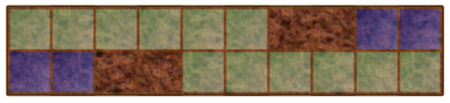
The field of play was traditionally a large branch, cut in half lengthways with 10 "traps" carved into each half of the branch - though any board with 20 (2 x 10) divisions will do. Two players sit opposite each other, with the playing area between them - the branch closest to a player is their "Land". For each player, the six rightmost traps on their Land - known as the "whelping traps" - are traditionally coloured light green (the colour of new life), while the two leftmost traps - known as "home traps" - are coloured blue (the colour of safety). The remaining four traps are either unpainted, or are painted brown:
Each player starts with 15 white or 15 black stones. The game is played in rounds, where each player attempts to score points by "bringing down" opposition stones or "bringing home" their own stones. The first player to score 21 or more points wins the round, and the first player to win 3 rounds wins the game. There are numerous betting strategies, including winning the game, winning rounds, scoring more points than your opponent in each round, bringing down or bringing home more stones, etc. It is common for 2 or 3 strategies to be employed for each game. I'm going to assume that playing the game without betting is unheard of.
I've tried to keep the rules down to a minimum:
The problem with these rules as they stand is that I have no idea how workable they are, whether they lead to one colour almost always winning, how quickly the game proceeds, what sort of strategies are available - though I've played the game against myself and already found that the most obvious starting moves can be countered by good defensive play. My experience to date has been that the game is more of a cat-n-mouse effort than a proper dogfight - the player to make the first mistake often loses; I'm also beginning to think that the player who is too defensive, or too reckless, will also tends to lose.
In other news, I've finished my Open University writing course. Hopefully I'll be able to post a few micro-short stories here in the not-too-distant future.
So I've had to come up with a game they can gamble with. Now I'm sure they have six-sided dice, and I'm certain their money has coins with different images on each side, so there's two methods of gambling right away. But I decided that they needed a game which is a little bit different from the norm. A game which requires a bit of skill and thought, but is simple to play. Also a game where chance is minimised to the opposing player's mistakes rather than by the roll of dice or shuffling of cards. A sort of cross between backgammon and mancala (seeding games fascinate me because of their apparent simplicity).
I've called the game òicustiỳtac (joicustijytac), which very roughly translates as dogfight, though an alternate name for the game could be òicusỳdahczy!ut (joicusjydahczy!ut) which is the action form rather than the object form of the word. The logographic rendering of the word is:

The field of play was traditionally a large branch, cut in half lengthways with 10 "traps" carved into each half of the branch - though any board with 20 (2 x 10) divisions will do. Two players sit opposite each other, with the playing area between them - the branch closest to a player is their "Land". For each player, the six rightmost traps on their Land - known as the "whelping traps" - are traditionally coloured light green (the colour of new life), while the two leftmost traps - known as "home traps" - are coloured blue (the colour of safety). The remaining four traps are either unpainted, or are painted brown:

Each player starts with 15 white or 15 black stones. The game is played in rounds, where each player attempts to score points by "bringing down" opposition stones or "bringing home" their own stones. The first player to score 21 or more points wins the round, and the first player to win 3 rounds wins the game. There are numerous betting strategies, including winning the game, winning rounds, scoring more points than your opponent in each round, bringing down or bringing home more stones, etc. It is common for 2 or 3 strategies to be employed for each game. I'm going to assume that playing the game without betting is unheard of.
I've tried to keep the rules down to a minimum:
1. All the stones are placed in a bag and each player draws out 5 stones. The player with more white stones has the right of first turn. If both players have equal numbers of white stones, then both will draw a further stone, with the player drawing a white stone against the opposite player's black stone winning the right to first turn. Bets are usually placed on who wins the right.
2. The player who wins the right to first turn takes 15 black stones, the opponent takes 15 white stones. Black plays first. Play moves in turns, during which each player may move one or two of their own stones or, if three of their stones occupy the same trap, those three stones. Moving more stones than permitted in a turn gives the opponent the right to "bring down" a stone of their choice before commencing their turn.
3. Each stone must first be introduced - "whelped" - to the field of play by the player placing the stone in one of their whelping traps. Up to two stones may be introduced in each turn. A stone can be whelped at any point in the round, and once whelped can be moved in any permitted way across the field of play. A player may choose to whelp a new stone and move another as part of their turn.
4. A player may move a stone vertically into the opposite trap in their opponent's Land.
5. A player may move a stone diagonally to the left out of the opponent's Land, the diagonal movement being either 1, 2 or 3 traps to the left.
6. An individual stone may only be moved once during a turn. An individual stone may only be whelped once during a round.
7. A player cannot move a stone to a trap if that trap is already occupied by a sufficient number of opponent stones, where at the end of the player's turn the trap will have two more opposition stones than the players stones. For instance white player cannot place a white stone in a trap already containing 3 black stones, but can place two or more white stones in that trap. If the trap contains 3 black and 1 white stones at the start of the turn, then white player can move one or more white stones into that trap. If the trap contains 4 black stones and no white stones, then the white player will have to move 3 white stones into that trap (assuming they wish to move stones into that trap).
8. Players may remove - "bring home" - their own stones from the field of play if the stone is in one of their own Land's home traps, but only if such a move leaves at least one stone (of any colour) in the trap. Bringing home a stone scores the player 2 points. Once a stone has been bought home, it may not be re-whelped to the field of play.
9. A trap may not contain more than 5 stones after a turn. If a trap does contain more than 5 stones, then the player who has just played their turn may remove - "bring down" - sufficient of their opponent's stones from that trap until it contains just 5 stones (for instance, if white player moves 3 white stones into a trap already containing 4 black stones and one white stone they will bring down 3 black stones, leaving 4 white stones and one black stone in the trap). If a player has to remove one or more of their own stones to bring the number of stones in a trap to 5, the stone must be given to the opponent as if it had been bought down by them. Bringing down an opponent's stone scores the player 3 points per stone.
10. The player who wins the round wins the right to play the black stones in the next round.
The problem with these rules as they stand is that I have no idea how workable they are, whether they lead to one colour almost always winning, how quickly the game proceeds, what sort of strategies are available - though I've played the game against myself and already found that the most obvious starting moves can be countered by good defensive play. My experience to date has been that the game is more of a cat-n-mouse effort than a proper dogfight - the player to make the first mistake often loses; I'm also beginning to think that the player who is too defensive, or too reckless, will also tends to lose.
In other news, I've finished my Open University writing course. Hopefully I'll be able to post a few micro-short stories here in the not-too-distant future.
Subscribe to:
Posts (Atom)